Tuesday, August 9, 2011

The Face, The Street and Henri Cartier-Bresson

ARENA magazine: "Photography and Public Space" 
"The Kiss, Bourke Street, 1978" Rennie Ellis Photographic Archive


Photograph: Robert McFarlane
Issues facing photographers who work in the public domain (pictured) - creating visual histories of our times (such as Melbourne's remarkable diarist, the late Rennie Ellis (1940-2003)http://www.rennieellis.com.au/ ) are not going away. (Distinguished photojournalist Michael Coyne explores this issue further on in this blog) Now, in the spirit of open debate ARENA magazine http://www.arena.org.au/ will host a discussion at their Project Space, 2 Kerr Street, Fitzroy, Melbourne, chaired by Melissa Miles, on Tuesday, August 16th, at 6 p.m. In a recent issue of ARENA Miles, together with Jessica Whyte, made this timely, acute observation: "In recent years everything from terrorism to paedophilia has been used to rationalise the restriction of photography in public while the social changes and anxieties that inform the restrictions, such as shifts between the public and the private, are obscured. Photography is uniquely suited to showing us un-encountered aspects of public life, and its power to make visible is central to the ways we structure, negotiate and experience the public and the private." Miles, a lecturer in Art, Design and Architecture at Monash University, will talk about this area of vital concern and Monash University's "Photography as a Crime" project. For further details, phone 03 9416 0232 or 0437 960 510 or go to ARENA magazine's website. http://www.arena.org.au/
STANDING YOUR GROUND, ON THE STREET
Just received this link from Hong Hong documentary photographer Bob Davis http://www.bobdavis-photographer.com/ ("Faces of Japan" 1978 Kodansha International) via Robin Moyer http://www.robinmoyer.com/portfolio.html  about a fascinating exercise carried out recently by six photographers acting on behalf of the London Street Photographers Festival. All were assigned to photograph, on the street, in public, in different parts of London as part of a LSPF project "STAND YOUR GROUND". Their filmed reactions, and those of police and officials, perfectly express the dilemmas faced by photographers working in public spaces today, worldwide. Caused partly by the paranoia created by recent terrorist acts in London, there was general confusion about what rights photographers have to document what is before their cameras. The London police, oddly, come out as the most reasonable of inquisitors into the world of photographing on the street - having, after all, to enforce the law - which clearly still allows the taking of photographs in public in Britain. Full details of this are included in the clip.
The Phenomenology of The Face
Actor and Photographer Stuart Campbell  (1951-2009) spent most of his life making faces - either as one of Australia's finest character actors, or in his less well known role as a photographer. Campbell never paraded his talent with the camera but his "eye" was highly sought after by fellow actors and 'showfolk'. Just how much delight Campbell took in the portrayal of his peers is currently on show at the mezzanine level of the Wharf Theatre of the Sydney Theatre Company. http://www.sydneytheatre.com.au/ Recently seen on exhibition at Canberra's National Portrait Gallery, where one of his subjects, author and friend Lee Tulloch, commented "Stuart Campbell’s gifts as a photographer were many but what made him unique was his ability to disarm his subjects with outlandish wit, shocking them out of their self-consciousness so that they revealed more of themselves than they had ever intended." Campbell had the simplest of photographic techniques - lighting that gave each sitter's face a luminousity and compositions that gave sculptural form to each person's body language. It is hard to escape the view that his portraits became essentially a vibrant dialogue, with each sitter eventually offering up the most intimate aspects of their personalities to Campbell's camera. This photographer was also clearly a devotee of classic black and white analog photography, reinforced by rich, traditional darkroom printing. Campbell was equally at home photographing men or women, whether the manic King Lear like antics of celebrated stage actor Ron Haddrick,(pictured, above left) the unmistakable, defined planes of Belinda Giblin's face (pictured, left) or the stillness he captured in Wendy Hughes' extraordinary face, early in her career.(pictured, above left) One of his most memorable images is of legendary Australian performer, Little Nell, pressed against the rough texture of a wall.(pictured, right) This unforgettable picture, with its partial nudity, is as hard to categorise, and as unforgettable, as Little Nell herself. Campbell's working life also paralleled that of Mel Gibson's Australian career, and we see an impossibly young Gibson in an early Campbell photograph.(pictured, above right) I first heard of this exhibition through a call received from film director Gillian Armstrong, a close friend of Campbell. After Campbell's death in 2009, Armstrong was instrumental in presenting his archive to the National Portrait Gallery. http://www.portrait.gov.au/site/exhibition_subsite_stuartcampbell.php?pagenum= Considering that Campbell had photographed many of the key figures in the renaissance of Australian film and theatre from the 1970's onwards, they were delighted to offer an exhibition, "Between Light and Shadow", which only finished in July. A spokesperson for Sydney Theatre Company said there is no closing date planned for the Stuart Campbell exhibition, at this stage. On display on the Mezzanine at the Wharf Theatre, Pier 4-5, Hickson Road, Walsh Bay, Sydney. 
POST SCRIPT:
I last saw Stuart Campbell (pictured right, in a self portrait) while I was working as a stills photographer on the set of the 1996 film "Dating The Enemy", which starred Claudia Karvan and Guy Pearce. Stuart Campbell had a small role playing, ironically, a photographer pursuing Guy Pearce's television celebrity character, in the intrusive style of the Paparazzi. While the director, Megan Simpson Huberman, was preparing for the scene in which Campbell would secretly photograph Pearce in Sydney's Hyde Park, Pearce wandered up to Campbell as he was busily assembling his impressive camera outfit, adding a very long, expensive looking, fast lens, for the scene to come. Idly making conversation, Pearce asked Campbell whether the camera and lens belonged to him. "No," answered Campbell, a little shortly, "they were supplied by the film's producers." Looking at the impressive array of lens and camera, Pearce casually continued, "bet you wish you could take them home." Campbell, who never made a secret of his gay sexuality, looked up at Pearce and replied, "No, but I wish I could take you home." The conversation abruptly ended there and Pearce moved away to diligently prepare for his next scene.
JESSE MARLOW TOPS "LONDON STREET PHOTOGRAPHY FESTIVAL"
Jesse Marlow L and Hannah White, R,  the  Event's Coordinator
No stranger himself to the photographing on the street, Adelaide photographer Gary Cockburn sent me this link from Edinburgh http://londonstreetphotographyfestival.org/contact where he is pursuing his long term project of documenting their Fringe Festival (along with Adelaide) Jesse Marlow (pictured, above) has a growing reputation as one of Australia's finest younger photojournalists (Marlow was selected recently for the World Press Photo Masterclass and has been critically well received for his droll observations on the visibly injured in his book, "Wounded" and an earlier book, "Centre Bounce", which documented indigenous AFL football in Central Australia. Marlow has now been announced as the winner (with Phillip Cheung as Second Prize Winner) of London's 2011 Street Photography Festival. To see Marlow's winning portfolio, go to http://www.jessemarlow.com/portfolio/dont-tell-them-show-them-page/  (pictured, above, one of his award-winning selection) Ironically I also recently received a link to an eloquent article written by acclaimed Hong Kong-based Black Star photojournalist, Michael Coyne, on the increasingly difficult environment faced by photographers working in the street. http://rising.blackstar.com/of-street-photographers-spies-perverts-and-pedophiles.html The street is the environment that defines a society. Consider how visually (and historically) poor we would be without the astonishingly agile, accurate observations of photographers such as Henri Cartier-Bresson, Josef Koudelka and Robert Frank. A society is greatly defined by how we are seen to live and restrictions on recording urban human activity are nothing if not shortsighted, stupid and in some cases, sinister. How would the revolutions currently unfolding in the Middle East have fared, had people agreed to such suppression?
HENRI CARTIER-BRESSON IS COMING TO BRISBANE.
Coincidentally, photographs by arguably the greatest street photographer of them all, Henri Cartier-Bresson, will soon be seen in Brisbane with the mammoth exhibition, "The Man, The Image & The World"  http://qag.qld.gov.au/exhibitions/coming_soon/henri_cartier-bresson opening on August 27 at the Queensland Art Gallery. On exhibition for three months, this extraordinary display shows how Henri Cartier-Bresson (1908-2004) charted the currents of artistic, cultural and political change within the 20th Century and promises to be the most expansive display of the great photographer's work yet seen in this country. Combined with QAG's other shows of Surrealism and Matisse, a journey to Brisbane would seem to be essential within the near future.
Text Copyright 2011 by Robert McFarlane www.robertmcfarlanephotos.com

Saturday, July 30, 2011

Masterworks From Three Centuries

An August full of Nuance, Whimsy  - and Menace.
STILLS Gallery http://www.stillsgallery.com.au/ have entered the new month with an exhibition"Artificial Spacial Systems" by Paul Adair, inspired by his 2009 residency in Los Angeles. This might suggest Adair has returned to Australia filled with the joy of art theory, and with the pictures to grimly prove it. Fortunately  there is an innate desire in Adair's deceptively simple pictures to entertain and sometimes confound the
viewer's perceptions, as in his earlier work, "Basketball 2008" (pictured, right). A.S.S. (as Stills Gallery has called Adair's new show) promises to reveal a further evolution of this photographer's vision. Until September 3 STILLS Gallery are also showing "Plant Life" and "Precarious", an exhibition and film by artist Merilyn Fairskye that explore the aftermath, a quarter of a century later, of the nuclear disaster at Chernobyl. After recent events in Japan, this exhibition will have special significance. Also until September 3.
At Point Light Gallery, Enrico Scotece has curated "Shadow Play", featuring the black and white photographs by eleven photographers (all traditionally printed on fibre-based paper) that explore moments more inferred than spelled out. Looking at Tony Sillavan's "Dark Wind" (pictured, left) with its corrugated waves of wind blown grass, I thought immediately (though I admit somewhat laterally) of French writer Francois Mauriac's description of bleak rural France in his 1927 novel, "Therese Desqueyroux". http://www.pointlight.com.au/  Until August 21
Australian & International Photography in Sydney
Photograph by Carol Jerrems

Photograph by David Potts

Now fully resettled in a former bank building in Anzac Parade, Kensington, the Josef Lebovic Gallery http://www.joseflebovicgallery.com.au/ are currently showing an extensive selection of Australian and International photography from the 19th, 20th and 21st Centuries. Josef Lebovic has long had a penchant for photography's first century and this exhibition is no exception, with extensive portfolios depicting life in Australia, especially, during photography's absolute infancy. It is the 20th century work, however, that shows a series of strong calibrations of the muscular new art form in this country - with works by David Potts (pictured, right) David Moore, Max Dupain, Roger Scott, William Yang, Josef Vissel and a photographer with a distinctive way of seeing and style of printing - Melbourne's enigmatic Robert Besanko. (pictured, below left) This photographer has a unique visual signature, especially when portraying the female form and once an image of Besanko's is seen, it lodges stubbornly in memory - ever sculptural and alluring. Another Melbourne enigma, the late Carol Jerrems, is represented by one of her, and Australian photography's finest portraits, especially of a woman - "Lynn" (pictured, above left) I confess this picture of a confident, intense young Australian woman resonated with me so strongly that in 1994 I selected it as the catalogue cover image for "Critic's Choice", a personal survey of the Art Gallery of NSW www.artgallery.nsw.gov.au/ Photography Collection that I curated at the time.It's wonderful to see it again in Josef Lebovic's gallery. (in the spirit of full disclosure I should also declare that as a photographer, I am represented by the Josef Lebovic Gallery) Until August 13.
Australian Talent Flowered in Manhattan, Long Ago.
Swimsuit advt, 1951 Photograph: Anton Bruehl 
Anton Bruehl was born to immigrant German parents in Naracoorte, South Australia in 1900, and emigrated to the United States nineteen years later. Coming from a country where his German father, a skilled Physician, Surgeon and Opthalmologist, effectively lived and practiced his profession under the political cloud of being a possible German sympathizer, it is perhaps not surprising that Bruehl, with his brother Martin, travelled to the United States to find a new life, and eventually, a new home for their parents. However, within a decade Bruehl had transformed his own life, turning a hobbyist interest in photography into a profession where he pioneered an elegant, graphic and for the times, erotic use of colour photography in magazines. After initially getting work as as an electrical engineer, Bruehl saw an exhibition by the students of legendary U.S. photographer Clarence H. White at the NY Art Centre that would change his life. "My hobby had (also) emigrated and I read ... books and attended exhibitions," he recalled in Gael Newton's book 'In The Spotlight'. "I found it (White's Student Exhibition) very impressive." Bruehl sought out White and persuaded the eminent photographer to teach him privately. Nothing if not decisive, the next day Bruehl took six month's leave from his employers, Western Electric, and determined "to try for a full time career in photography". He never went back. How brilliantly the young Australian succeeded is on exhibition in the National Gallery of Australia http://www.nga.gov.au/  touring exhibition "Anton Bruehl - Into The Spotlight", at Melbourne's elegant Monash Gallery of Art www.mga.org.au/ until September 11. Bruehl would master not only the technical demands of large format colour photography for reproduction (he would work extensively for pioneering magazine publisher Conde Nast) but would develop a style of photo illustration for advertising, that in hindsight, shows some kinship for the affectionate portrayal of Americal life employed by illustrator Norman Rockwell. The difference with Bruehl was in his portrayal of women. Using elegant, sometimes surprisingly explicit nudity, the charming young Australian produced subtly coloured images that eschewed sentimentality and, at their best, gave their subjects unmistakable erotic appeal. When one photograph (pictured, above left) of model Ruth Corlett, quite obviously nude and wearing only a bright red, circular hat, was deemed too risque for the US Postal Service and moved from the cover of U.S. VOGUE to inside the magazine, Corlett drily protested, defending its tastefulness, as Gael Newton noted, saying, "(but) I was adequately clad in Mr. Bruehl's best shadows."
Beneath Bruehl's elegant colour fantasies and his complex theatrical tableaux, there was also yet another photographer waiting - capable of mastering austere, beautifully exposed and printed observations of society - specifically, a series of images which Bruehl made in Mexico, and which he then published in luxuriant, finely reproduced book form. Photographs of Anton Bruehl at the peak of his career reveal a handsome young man apparently enjoying life by taking playful, yet professional delight in the elegance and beauty of his subjects. This exhibition is not to be missed. Until September 11 and afterwards in January 2012 at the Queensland University of Technology Art Museum.
TAKE - A Fine New Avenue for Australian Photography
Austalian photographers now have a new, well reproduced and designed magazine in which to showcase their photography. TAKE magazine. Part of a stable of magazines which also includes the excellent, provocative  art magazine EMPTY, TAKE http://www.takephotomag.com/ will be published twice a year and offers a series of portfolios of fine, contemporary Australian and International photography. Once again, seen en masse, it is difficult to escape the conclusion that photography in this country produces some remarkably individual visions - such as those of Adam Ferguson, Lisa Wiltse, Martin Mischkulnig, Jessica Tremp and David Flanagan.
Gone But Not Forgotten
Two remarkable exhibitions that have since closed but which should not be forgotten are Prudence Murphy's "Boys with Guns", an exploration of boys and their traditional obsession with playing games featuring guns, (pictured, above) and seen recently at the Monash Gallery of Art and Ella Dreyfus's remarkable colourist visions "To See Beyond What Seems To Be", recently shown at Articulate Project Space  http://www.artwhatson.com.au/articulateprojectspace/to-see-beyond-what-seems-to-be (pictured, above right) in Sydney. Both artists are difficults to categorise, with Murphy http://www.prudencemurphy.com/cv.html showing her series of droll observations of young boys playing with weapons - while Dreyfus, well known for her portraits and unsentimental, brutally honest nudes, showed a series of seductive images suffused with colour, but little defining detail. http://www.elladreyfus.com/news.php Looking at her photographs I thought immediately of two artists from  very different centuries - J.M.W. Turner with his vistas overwhelmed by colour and suppressed definition; and Lloyd Rees, whom I photographed in 1982.(pictured, right) With his fading eyesight, Rees (1895-1988) was reduced, as he diligently rolled his sleeves up to paint every day, to creating a wan Impressionism.
POST SCRIPT for "Boys With Guns"
When looking at the seemingly trivial domestic vistas in which Prudence Murphy's young subjects play out their fantasies, I was drawn to thoughts of the recent ghastly mass atrocity in Oslo, and reminded myself that it was perpetrated by an open-faced, handsome young man, nourished, we are told, by fear, prejudice, a love of guns and the explicit, mimetic games he played incessantly on his computer.
Text Copyright 2011 Robert McFarlane http://www.robertmcfarlanephotos.com/

Wednesday, July 27, 2011

How Far Have We Come?

 Mick Rock - Exposed, and Extended at Blender

Singer Debbie Harry of Blondie Photograph by Mick Rock


David Bowie Photograph by Mick Rock


Photographs by Mick Rock, known as "The Man Who Shot the 70's", are on display at Blender Gallery for another three weeks http://www.blender.com.au/exhibitions/mick-rock-exposed/ in Paddington Sydney. The exhibition was to finish this weekend but because of public interest, Director Tali Udovich has extended the show until August 20th. Mick Rock is perhaps the most stylised and conceptual of rock photographers, but still capable of simple, honest reportage when required. Blender Gallery appear to have happily gone over to the 'dark side' and now describe their gallery as "Specialists in Music Photography & Rock 'n' Roll Prints". This would appear to be a good thing as Rock and Roll's pervasive presence in youth (and not so young) culture deserves passionate, critical exposure. In the past Blender Gallery have done this regularly through exhibitions including photographs by Ethan Russell, Henry Diltz and Australia's Tony Mott, Philip Morris and Bob King.
With this exhibition, Blender Gallery also launched Mick Rock's latest publication, "MICK ROCK - EXPOSED - The Faces of Rock 'N' Roll". Everyone from rock culture's past four decades are here - Queen and its melancholic leader, the late Freddy Mercury, Syd Barrett, Lou Reed, Blondie, Iggy Pop, right up to the current Queen of Art Rock, Lady Gaga. (I recently caught her latest television performance by chance, on Saturday Night Live. Suitably extravagantly clad, Lady Gaga sang brilliantly, proving she is much more than just her amazing visuals.) In his book, Mick Rock contributes a revealing introduction, offers detailed captions for each picture but also includes an essay by eminent British playwright Tom Stoppard. (The book is on sale at Blender Gallery at its recommended retail price of $50.00)
Fast, Digital Compact Cameras continue to surprise
Nikon SP camera with 35mmf1.8 Nikkor


Nikon Coolpix P300 digital camera

The new generation of compact digital cameras with fast wide angle zoom lenses started with Samsung's EX-1 and continued with new models from Olympus and Canon. (ozphotoreview has already favourably reviewed Canon's fine S95) This trend continues with Nikon's outwardly modest Coolpix P300. (pictured, left) However, this simply styled camera has a number of surprises in store. I quickly found it remarkable for both versatility and image quality. After travelling with this camera to Sydney and using it under a wide variety of lighting conditions I came to the conclusion that fast digital compacts, having roughly the same dimensions as a pack of playing cards, were capable of equalling (perhaps surpassing) the versatility of the great 35mm rangefinder workhorses from a half century ago - such as Canon's VIT and the Nikon SP.(pictured, above right) If this seems an ambitious claim, consider the fact that the Coolpix contains essentially the same focal lengths within its zoom lens as a Nikon SP with 25, 50, 85 and 105 lenses, but also shoots HD video. However the SP, favoured by many LIFE and LOOK photojournalists in the late 1950's and early 1960's, was equal to any picture-taking situation in its era. With its fast 35mm, 50mm and 85mm lenses, this camera represented the pinnacle of Japanese coupled-rangefinder camera design. (Nikon S rangefinder cameras began their life as picture-taking instruments clearly derived from pre-war Zeiss Contax cameras. Constant improvements at Nippon Kogaku quickly transcended the original German design) But after the Nikon SP reached its peak, there would be no more Nikon rangefinder
 Martin Sharp at "Wirian" Photograph by Robert McFarlane
rangefinder cameras with interchangeable lenses.
Tiny Tim, Luna Park 1979 Photograph by Robert McFarlane


Psychologist Michelle Sexton

This would mark the beginning of another tradition: the introduction in 1959 of a new camera that would quickly become famous for its extreme durability - the Nikon "F" 35mm SLR (but that's another story) Using its advanced viewfinder, the Nikon SP could accomodate lenses 
Jade, taken with Nikon P300
from 28mm wide-angle to 105mm telephoto-and longer using a mirror box. And between 35mm and 85mm, lens speeds commonly ranged from 1.4 for the 50mm, to f1.5 for the fastest 85mm medium telephoto.(there was even a rare 50mm f1.1 Nikkor) Photojournalists loved the speed and quality of these lenses, and the ability to accurately frame and focus using the SP's excellent rangefinder. Much of the turbulent political history of the United States in the 1960's would be recorded by men and women using this camera. I thought about the Nikon SP, surely one of the most elegant camera designs ever, and its remarkable capabilities when I picked up the diminuitive Nikon Coolpix P300. The zoom ratio of the P300's Nikkor lens was modest (4.2X) but the speed and angle of view at its widest setting was not - f1.8 and the equivalent of 24mm. Neither was the len's sharpness. When I visited an old friend, artist Martin Sharp, while in Sydney, I made a few simple portraits of this remarkable painter, printmaker, film director and writer at his Bellevue Hill home - the sprawling mansion "Wirian" - filled with a half-century of Sharp's remarkable artistic output. (I had enjoyed the privilege, in January 1979, of being one of the photographers invited by Sharp to document the presence in Sydney of U.S. singer Tiny Tim.) Sharp was directing "Street of Dreams"  a definitive documentary film of Tiny Tim (1932-1996) in performance at Sydney's Luna  Park showing the remarkable troubadour breaking the World's Non-Stop Singing Record. (pictured, above) As I photographed Sharp, I periodically checked the sharpness of the Coolpix P300 pictures on the very fine resolution LED monitor, I was surprised and delighted by their sharpness, colour balance and appropriate contrast. Clearly this camera, with its 12 megapixel backside-illuminated CMOS sensor, was capable of making pictures of professional publication quality. I would later make a series of spontaneous portraits of a lawyer friend, Jade, in the bright, contrasty light of Sydney's Redfern streets (and also a close-up portrait of Adelaide psychologist Michelle Sexton taken indoors under more subdued light) that illustrated this camera's qualities well. Sharpness, contrast and colour balance all proved exemplary. Enthusiastic amateurs and professionals alike can take confidence in this latest member of the new generation of pocketable cameras - while also noting the Coolpix P300 shoots full 1080 HD video. (the Coolpix sports a built-in stereo mike and includes the increasingly popular panoramic mode) Picture-taking menus were simple and I found myself only occasionally drawn to the User's Manual.
"Pope Alice" Returns to the ACP.
"Pope Alice" at Lake Galilee, Qld. Photograph by Luke Roberts
The Australian Centre for Photography http://www.acp.org.au/ is currently showing two exhibitions which encompass important perimeters of current art practice: Luke Roberts is presenting AlphaStation/Alphaville, yet another courageous, unsentimental exploration into personal identity, as well as revisiting one of his most potent creations - the elusive, mythic and slightly ominous presence of Pope Alice. (pictured, above) Inspired, and perhaps provoked by his strict Catholic upbringing in Queensland, Australia (and Roberts' reaction to the Catholic Church's abhorrence of homosexuality) Pope Alice now has a wandering life of her own in the hands of this dedicated artist. Typically, Roberts has added an extra, ironic touch to his panoramic evocation of the celestial Pontiff - by photographing her at Lake Galilee. Not the same body of water as in the Holy Land, but in a remote, waterless part of Queensland. Until July 23 Practising What You Preach, and also Show.
Photograph by Steve Lock

Photograph by Angela Rose Woods
On display at the same time as the sadly soon to finish exhibition by Luke Roberts, is work by the students at the Australian Centre for Photography. This current exhibition reveals at least two of the extremes of modern photography - images which could only be produced in the age of Photoshop - and pictures so fluid, observational and brilliantly narrative, (pictured above left) that thoughts of artifice simply do not occur. And as the former husband of brilliant illustrator, Kate Burness (her remarkable 1973 Rolling Stones poster was featured in Get On Down (pictured, right - with the book using Martin Sharp's brilliant poster for Jimi Hendrix as the cover image) http://www.poster-books.com/music/get-on-down-a-decade-of-rock-and-roll-posters.shtml) I am aware of the skills possessed by talented, imaginative artists. But when I saw the wonderful photo-illustration created by Angela Rose Woods (pictured above) I had to acknowledge what may be dreamed, can now be made real through software such as Photoshop http://www.adobe.com/products/photoshop.html  challenging the traditional draftsmanship and classical colourist skills possessed by artists such as Burness.
But There's More! Coming Attractions at the ACP.
Photograph by Lloyd Godman

Starting on July 29th are two exhibitions that exploit  photography's traditional strengths. In Gallery 3, Lloyd Godman will present Entropy, a suite of colour photographs that illustrate how the Australian bush regenerated after the tragic Victorian bushfires of 2009. (pictured, left) Accompanying Godman will be Disappeared by Remained an exhibition of Korean photographers (one of retiring ACP Director Alasdair Foster's achievements has been to embrace the reality of Australia's presence in Asia and the Pacific) The artistry of the Korean people is often overlooked when considered in context with their phenomenal capacity for imaginative hard work (a contemporary Korean saying proclaims 'we are the only people who make the Japanese look lazy!) 
Photograph by Woon-Gu Kang

Photograph by Ki-Chan Kim


Disappeared but Remained offers the work of three distinguished Korean photographers: Woon-Gu Kang, Ki-Chan Kim, and Gap Chul Lee in an exhibition curated by the Museum of Photography, Seoul.

Each understands the idea that every photograph, in some way, is an elegy for a past experience or person. Defying global artistic trends, Korean photographers pursue what their spokesman called, "the essential characteristic of photography: the representation and preservation of reality. The photographers ... (and) focus on documenting disappearing moments, places or objects (within) the radical social change of South Korea’s rapid industrialization and westernization."
Just out: 2011 Compendium of Australian Photographers.

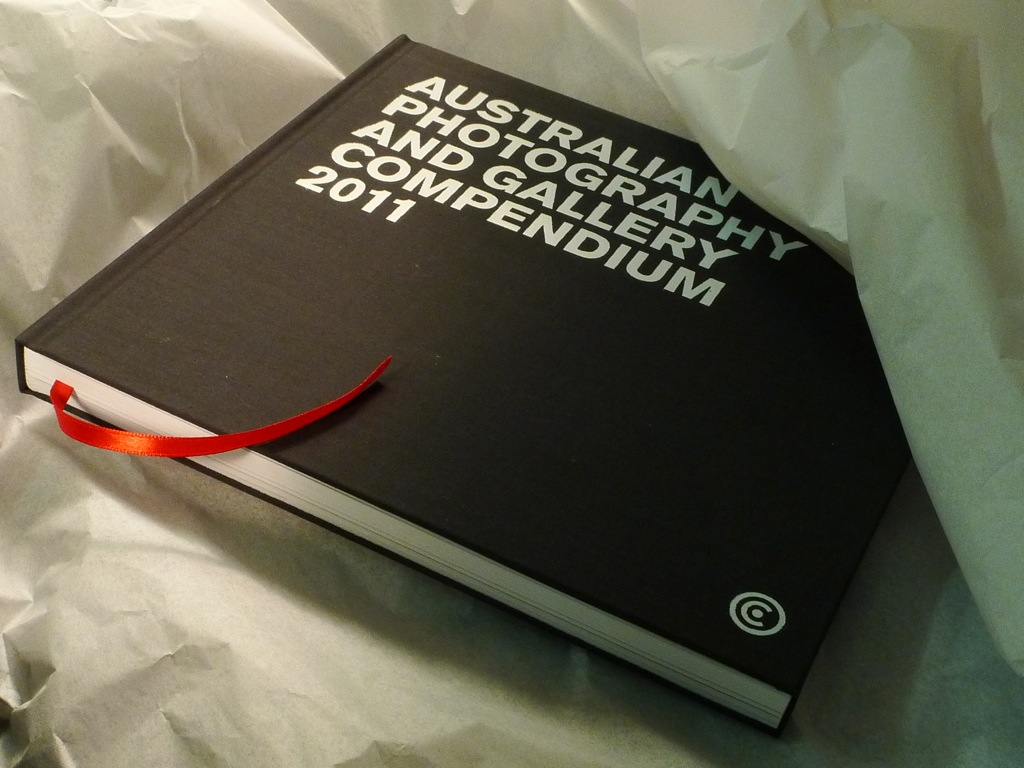
Just off the presses in China is a remarkable addition to Australian publishing - a beautifully designed and reproduced book which contains the work of the vast majority of photographers (over 130) who exhibited in recognised Australian art galleries during 2011. Each photographer supplied one photograph and accompanying text with their contact details. The Compendium(pictured, left and right) was created by Mary Meyer and Bob Kersey, founders of the Meyer Gallery http://www.meyergallery.com.au/ and becomes, after the quickest reading (a copy arrived only hours ago) a uniquely valuable source of reference for the current (and annual) state of this dynamic Australian art. To obtain copies, please contact Mary Meyer on 0409 971 940 or visit http://www.thecompendium.com.au/ to find out how to participate in future editions.
Text: Copyright Robert McFarlane 2011 http://www.robertmcfarlanephotos.com/ 

Saturday, June 11, 2011

The Unchanged, and Adorned Landscape

Greg Weight's Night Masterpiece on Show in Melbourne

"East of Emily with meteorite 2009"  Photograph by Greg Weight


"Formations 2010" Photograph by Greg Weight
 19th and 20th Century Australians of European origin grew up nourished by the fiction that this continent's heart was dead - a lifeless, threatening landscape completely opposed to the residual, mythic imagery of a European Arcadia from whence we came. This pervasive fiction has been, however, consistently eroded, firstly by our painters - from Fred Williams, Arthur Boyd and Sidney Nolan to the seemingly photographic-inspired visions of William Robinson http://www.evabreuerartdealer.com.au/robinson.html Photographically, the inner, beating heart of Australia has been unsentimentally recognized by a generation of 20th Century photographers from - Wesley Stacey http://www.photo-web.com.au/wesley/intro1.htm and David Moore http://www.davidmoorephotography.com.au/ to the more recent, epic 21st Century visions of Murray Fredericks www.murrayfredericks.com.au/ and David Flanagan. http://www.davidflanagan.com.au/ The poetic, planetary, aerial abstractions of Richard Woldendorp http://www.richardwoldendorp.com/ offer an even more seductive alternative. Woldendorp makes no attempt to gild Australia's lily; instead this Dutch-born Western Australian has captured the Australian landscape as he finds it, but through a deeply informed, artistic vision. It is impossible to look at Woldendorp's photographs of a raw, Australian landscape, taken from the air, without gathering painterly references from generations of Australia's greatest 20th Century artists - especially including indigenous painters . To this mix of artists comes yet another unique vision. Visual veteran Greg Weight www.gregweightphoto.com.au/ - equally literate in photography, sculpture and painting (Weight's partner, appropriately, is accomplished painter and GalleryEast director Carol Ruff http://www.carolruff.com/ The Sydney-based photographer brings a simple, poetic vision laced with humility, to portraying our land. Weight's pictures entrance the viewer by intimately conveying, for example, the feeling of standing in a distant Australian landscape after dark, beneath a luminous inland night sky. Weight's colour image of a serrated ridge, with its spindly trees caught against a darkening canopy (pictured, above) through which a falling meteorite traces a faint line of light, is nothing less than a masterpiece. There is another, disparate string to Weight's artistic bow, however. This veteran artist has also attempted the seemingly impossible - supplementing the Australian landscape with a form of installation art - by subtly altering the vistas he photographs. By positioning a series of alien, bound, tree-like structures (pictured, below) Weight unexpectedly adds to our sense of the Australian landscape, while also acknowledging his understanding of Indigenous Australia and our art in general. Weight asserts that "they appear in concert with each other and ... the landscape. With their branches tied, ... landscape beyond becomes more visible ... more sculptural. Placed by nature. Shaped by hand." The central desert of Australia is enormous and alive, adds Weight and making these photographs was, he maintains simply, "a very small and ephemeral gesture to do with contemporary intelligence in a timeless place."  At Melbourne's Australian Galleries www.australiangalleries.com.au/ until June 26
The Co-Parent of Digital Photography Dies at 86
2009 Nobel Prize for Physics Laureate Willard Boyle 1924-2011 (pictured, left) the co-inventor (with fellow Nobel laureate George E. Smith 1930-) of the Charge-Coupled Device (CCD), which first made digital photography possible, has died in Wallace, Nova Scotia, Canada on May 7. Boyle's achievement in co-creating the charge-coupled device in 1969 effectively ushered in a revolution in photography. "After making the first couple of imaging devices," remembered Boyle, "we knew for certain that chemistry photography was dead." Boyle reportedly told his artist wife  Betty on the day he and Smith had worked on the CCD concept, "George and I did something special today." Later Boyle recalled that the two physicists' discussion had lasted little more than an hour, during which he and Smith 'batted some ideas around' and came up with the CCD. “We realised here is something that is pretty interesting because it will for the first time enable technology to store photographs ... transmit them and use them somewhere else.” Boyle, a Canadian, had already enjoyed a long, distinguished career as a physicist, which included (with Don Nelson) inventing the first continuously operating ruby laser in 1962, during his time working at America's legendary Bell Labs in New Jersey. In another, earlier, very different career, Boyle flew Spitfires for the Fleet Air Arm in the Royal Canadian Navy during the Second World War. (at war's end, Boyle was undertaking training landing Spitfires on aircraft carriers.) Boyle was also director of Bell Labs' Space Science and Exploratory Studies in 1962 and helped select the U.S. lunar landing sites. Later sending of images from the 1969 Moon landing to Earth used his newly designed CCD technology.
The Redefined Moment

"Resurgence 2010" Photograph by Darren Harris


LtoR: Tony Egan, Bob Kersey, Jenny Templin, Mary Meyer

 While I was last in Sydney I visited a gallery that primarily shows photography, the Meyer Gallery http://www.meyergallery.com.au/ to see Darren Harris's "Psychological Portraits", a series of black and white images that provided  impressionistic portraits of humanity's most inner landscapes. Reminiscent at first glance of South African artist William Kentridge's remarkable black and white drawings, Harris, who has a background in psychology and counselling, created images which extended and layered the photographic  moment (pictured, above) While at the gallery I noticed that Mary Meyer, her partner Bob Kersey and Tony Egan http://tonyeganphotography.com/about.html and Jenny Templin http://www.sydneycommunitycollege.com.au/tutor/200 (pictured, above, in a picture I made with the impressive Nikon Coolpix P300 which I am reviewing for a future blog) were all captivated by a website for the late Vivien Maier http://vivianmaier.blogspot.com/ whose photographic archive has only recently been discovered. Maier's artless, heartfelt style reflected a lifelong committment to documenting everyday life, and marked Vivien Maier (1926-2009) as a truly memorable amateur - in the best sense of that word. Darren Harris's exhibition closes June 11.
Distilled Moments from Another Century.
One of the great strengths of Australian fine-art photography is the freedom with which artists pursue the most personal, differing visions - from, for example, the fabricated emotional fantasies of Polixeni Papapetrou http://polixenipapapetrou.net/ to the exquisite, but differing still-life images of Marian Drew, http://robingibson.net/artists/marian-drew Anna-Maryke Grey http://www.anna-maryke.com/ and Robyn Stacey http://lightjourneys.net.au/artists/robyn-stacey/ Where death frequently permeates Drew's meticulously constructed tableaux, Grey and Stacey deal with the residual evidence of lives lived fully, long ago. Any new exhibition by Robyn Stacey always radiates visual evidence of her continuing love affair with colonial Australia. The mature vision of this artist conjures feelings of an era where silicon was only found in sand on the beach, and if you called someone, hopefully it meant they were within earshot. At Stills Gallery until June 25
http://www.stillsgallery.com.au/exhibitions/index.php?obj_id=main&nav=1
"Received Moments" opens at Orange on June 17

"Christmas Eve, The Paradise Club, Kings Cross c.1966"

"Robyn Archer in Tonight-Lola Blau c.1982"

 Expertly curated by Sarah Johnson, my 1961-2009 retrospective is slowly coming to the end of its long tour through the excellent, inclusive (and enlightening) Australian regional gallery network. I am travelling to Orange Regional Gallery http://www.org.nsw.gov.au/ next week to open the penultimate showing of this body of work. I once opened a show in Orange by an old friend, Barry Flakelar, and found their new, modern gallery diverse, welcoming and exciting. Each one of the regional galleries where "Received Moments" has been shown, from Maitland to Broken Hill and the Gold Coast, has taken a slightly different tack with how they displayed the pictures. I look forward to seeing Director Alan Sisley's interpretation. The tour of these pictures has only reinforced my belief in the importance of regional Australian communities. (it's final season opens at the Flinders Art Museum, North Terrace, Adelaide, on October 29 http://www.flinders.edu.au/artmuseum/index.cfm?mid=2&sid=0 )
Until July 31.
"I am a Camera" opens at Adelaide's Greenhill Galleries
A diverse and intriguing group of fourteen photographers have contributed to Adelaide's latest photographic exhibition at Greenhill Galleries, North Adelaide. Paul Lloyd's sensual colour images of Australian flora (pictured) were accompanied in the photographer's notes by this appropriate verse:

    Little flower – but  if I could understand
    What you are, root and all, and all in all,
    I should know what God and man is.


(from Tennyson's "Flower in the Crannied Wall")

Evocative nudes (pictured, left) by Gianna Grbich, broadcaster Richard Morecroft's illusionist landscapes (pictured, right) and a welcome showing of new work by veteran photographer and teacher, Ed Douglas, makes this exhibition compelling viewing. Until July 5
http://www.greenhillgalleriesadelaide.com.au/current_exhibitions.php
Text copyright Robert McFarlane 2011 http://www.robertmcfarlanephotos.com/