Going, going ... gone!
Like her friend and fellow artist Trent Parke, Adelaide-based photographer Wend Lear www.iwish.org is preoccupied with photographing the nuances of street life. Sadly her intriguing exhibition "blindspot" has just closed at the Hill Smith Gallery www.hillsmithgallery.com.au in Adelaide but I was lucky enough to visit the display with the artist, on the last day. Stylistically Lear, 40, works in a distinctly square format, compared to Parke's 6x7cm film format and presents her
 observations in tightly butted pairs - diptyches either similar in image content or blatantly incongruous. Like Parke, Lear (pictured, left) also sets the street back where it belongs - as a theatrical stage on which humans play and work. The atmosphere in her colour images is cool and graphic, with human presences subtly inferred, whether through pedestrians' limbs barely emerging from the shadows - a single word "self" labeling a streamlined facade on a modernist building - or mannequins stacked in store window disarray. Lear is an interesting, complex photographer and the coolness
 displayed in this
  exhibition was vividly contradicted by a catalogue she showed me of photographs made on self-assignment to Palestine in 2007 (pictured, left). Here, Lear's streets (and interior environments) were vividly rendered though the tragic, fractured prism of the Middle East. After looking through these colour images, Lear's photographs at the Hill Smith Gallery seem to take on a positively therapeutic, meditative nature - for both their author and this late arriving gallery visitor.
THE OCCASIONAL IMAGE
 Photographer Phil Klaunzer www.philipklaunzer.com has had an interesting way of seeing the Australian landscape for some time; I recall reviewing for the Sydney Morning Herald a series of his evocative landscapes celebrating a sense of place, Spirit of Place, at the Addison Road Art Gallery, in Marrickville, Sydney. While this blog is mainly dedicated to exhibitions and photographic issues, I intend to periodically show photographers' works in progress, such as these intense landscapes by Klaunzer, taken on a recent odyssey to Lake Mungo which, the photographer tells me, is 1000 kms west of Sydney and roughly 110 kms from Mildura. "I've been interes
 ted in the place for many years." says Klaunzer. "It's the oldest site of ritual cremation(s) anywhere in the world and is widely recognized as having been continuously occupied by Aboriginal people for over 50,000 years. I am (also) interested in the passage of time for humans on the planet. It is such a strange landscape that as a photographer I'm drawn to it. The earliest ice age human footprint is literally there." Klaunzer photographed this suitably planetary landscape digitally, originally in colour, (except for the star-trail image, above) but decided to convert his digital colour images to black and white. "I thought it was more in keeping with the graphic nature of the landscape itself - more pure," says Klaunzer, adding, "I used SILVEREFEX software http://www.niksoftware.com/silverefexpro/usa/entry.php which is brilliant and can replicate a filmic 'feel'. I am doing print tests at the moment. I did a couple of tests on a metallic paper and it kind of really suited ... " More later on this intriguing project.
 Gary Cockburn - Taking Coals to Newcastle
 Another talented Adelaide photographer is making waves, this time in another country, exhibiting his distinctively stylized colour images of the Adelaide Fringe (pictured, above) to the home of such inclusive festivals - the Edinburgh Fringe.There is a serious feeling of strangeness in Cockburn's pictures, but achieved without any obviously mannered trickery. This photographer instead relies on subtle timing and a visual signature that is both entertaining but at the same time true to the scene before his lens. No mean feat. In a note from Edinburgh, Cockburn detailed the interest (and frustrations) he has had in displaying his work in Britain, further. (pictured, left) "Met the Australian Deputy High Commissioner at lunchtime, and managed to show
  him some of the work (on my mobile again – it's one of the new Apple iPhones and has a truly incredible screen). Think he'd seen about ten shots or so before he was talking about the idea of exhibiting them at Australia House. Unfortunately one of his assistants was nearly as quick to point out that it wouldn't work. They
 only have one room that's suitable, and that's only if they spend £20k on temporary walls (since the building is heritage listed) to allow a hanging system to be installed. There's also the problem of the room in question being inside their security cordon." Travellers to Scotland can see this exhibition of Cockburn's photographs at Into The Fringe, "C" venues, Chambers Street, Edinburgh, Scotland, U.K and this link http://www.edfringe.com/whats-on/exhibition/into-the-fringe. - until August 30
LATE NEWS: Dean Sewell - now on a hat-trick with the Moran Photographic Prize
For the second year running, Sydney photojournalist Dean Sewell has won the $80,000 Open Section of the Moran Contemporary Photographic Prize, with a typically candid observation, (pictured, below) capturing a traditional Sydney moment - the atmosphere inside the Cockatoo Island ferry. Sewell has made a career of photographing Australian life above and below ground - from the perilous lives lived by the Cave Clan, who explore the maze of tunnels beneath Sydney - to more recent observations of the rivers of Australia within th
 e Murray/Darling basin. Accomplished combat photojournalist and documentary film-maker Stephen Dupont http://stephendupont.squarespace.com/ who judged the Moran Prize, said, "This year's Moran (Prize) judging was a visual rollercoaster ride through contemporary Australian landscape and society. Many ... entries were moving and surprising ... making the final selection ... unbelievably challenging ..." Dupont then wen
 t on to praise the photographs entered by school students
 , a unique feature of the Moran. "Many produced work of a high standard, fresh and inspiring. Not just simple pictures ... but moments of time, place and history." CEO of Moran Arts Foundation, Mark Moran added, "amongst many artists and now significantly, schools,the (Moran) Prizes are now considered a leading cultural event ... a million hits a month online at www.moranprizes.com.au confirm how (our) Prizes and art are ... engaged at a grass roots level in Australia." I personally enjoyed the playfulness of some entrants, such as year 11/12 student Christine Butcher's digitally manipulated "20 year drought" (pictured, right) and Patrick Riley's dead straight, emotionally engaging black and white portrait "Eleanor Weare" (pictured, left) Secondary school awards went to: Year 7&8 Lorren Chiodo: $2,000 for "Falling". Year 9&10 Tamara Schier: $2,000 for "Innocent Killers". Year 11&12 Annie Rose Armour: $5,000 for "Brother". An equal amount to each student's prize was awarded by the Moran Art Foundation to their respective schools, to assist in purchasing photographic equipment. The Moran Prizes are on exhibition at the N.S.W. State Library until September 5 before touring nationally.
Trent Parke - on exhibition in Adelaide at Hugo Michell Gallery
 In the middle of an incandescent career that has seen Trent Parke become the first Australian photographer to join the legendary photo-agency Magnum Photos, http://blog.magnumphotos.com/ the thirty nine year old Australian has, with his wife Narelle Autio and their children, recently chosen to live, work and exhibit in Adelaide, currently showing a mixture of old and new work at Hugo Michell's stylish Beulah Park gallery. http://hugomichellgallery.com/Parke, with Autio, his equally talented partner in life and art, seem to have discovered what John Lennon suggested several decades ago: "Think globally... act locally". Speaking briefly with Parke (pictured, right) at the exhibition's opening, he described being courted by perhaps the world's premier photographic book publisher, Steidl http://www.steidlville.com/bo
 oks/ run by its passionate, startlingly decisive founder Gerhard Steidl. Typically, Parke's attitude was equally fearless, considering he was on the verge of signing a book deal with another well known publisher - a highly desirable goal, one might assume, until he heard Steidl wanted to meet. (word is clearly out on Parke's talent) "After Magnum’s annual general meeting in New York in June this year, I flew straight to Germany to see Gerhard. He had already made the decision to publish Christmas Tree Bucket and Minutes To Midnight, and together we laid out both books in three days. His next question was only: 'What paper do you want for Minutes To Midnight?' I looked at a paper stock that was almost like heavy, traditional (fibre-based) silver paper, and he simply said 'fine'.” Parke's pictures at Hugo Michell Gallery range from large, almost floor to ceiling black and white prints of photographs taken during he and Autio's 2003 odyssey around Australia, to slightly smaller colour prints of later work (pictured, below) with a selection of newer black and white pictures displayed in a smaller, adjoining space along with several of partner Autio's magical undersea observations. Looking at Parke's pictures again, after some time, I was again struck by how
  quickly the viewer passes the borders of each image to be forcefully - even urgently - confronted by this gifted artist's celebration of the phenomenal hidden within the ordinary. The 2005 moment observed as a young woman pauses before crossing George Street, Sydney suggested something much older to me - the way street scenes since Pompeii have defined our lives through the significance of seemingly trivial details - such as in this picture of a sign simply saying "Today Coldwater $1.50" or visible evidence of the wind that ruffles the woman's skirt. And an astonishing, aerobatic flight of flying foxes filling the skies above the remote Northern Territory community of Matara
 nka (pictured above) recalls nothing less than a sci-fi moment of soaring, predatory alien paratroopers. Nearby we get to share Parke's amazement at the savage face of a feral pig-hunter's dog, Conan, (pictured, left) or a small boy's helpless seduction by a tiny glowing television screen, glimpsed by Parke in an anonymous caravan park. Parke seems effortlessly drawn towards such archetypal, sometimes untidy moments, which, like his nearby black and white print of a careering white horse photographed at dusk, are now stubbornly lodged in our memory. Until August 28.
IMAGE/TECH
Canon Australia announce two new smart, Pixma wireless printers
 Canon www.canon.com.au have responded to the need to print wirelessly, PC free, from the new generation of smartphones by introducing two elegantly designed WiFi printers, the Pixma MG6150 and the top of the line Pixma MG8150 (pictured, above) each featuring an arsenal of useful features: Easy PhotoPrint for wireless printing from Apple iPhone and iPod, durable Chromalife 100+ inks (print permanence is a given these days) and a user friendly interface Canon call their Intelligent Touch System. There is also a new feature which responds to another recent, popular technology - HD video. Both printers offer what Canon calls full HD Movie Print in which it is possible to print out individual frames from HD movies. I suspect there must be some enhancement involved in this mode, but it is an interesting response to the convergence now occurring between digital still and HD video cameras. Two other features also caught my eye. Both printers have six inks and Canon technologies such as Wireless LAN - print/scanning from anywhere at home. Their 9600x2400 dpi printing also has dedicated black and grey inks to produce quality grayscale B&W prints as well as colour - creating, according to Beryl Thomas, Canon's brand manager, "a 4x6 inch borderless photo of superb quality in approximately 20 seconds." The other feature that will undoubtedly prove useful is the Pixma MG8150's ability to scan film transparencies and negatives. Their specifications, just supplied, promise a remarkable 0ptical resolution of 4800 x 4800 dpi and negative and transparency scanning at 4800 x 9600 dpi. The world's photographers may have gone digital but Canon's experience building excellent scanners for film (and prints) suggests they have not forgotten traditional photography's origins and the ongoing need photographers have to digitize their film archives. Both Pixma printers are available in October 2010 with RRP's to be announced.
Copyright Robert McFarlane www.robertmcfarlanephotos.com 2010
Alfred Stieglitz - a complex photographic legacy - on show at AGNSW

 Alfred Stieglitz (1864-1946) lived at the pivot of the modern age in American and world art. It is difficult to think of his photographs today without sensing the thrust of modern energy then pulsing through early 20th century America - a society brimming with technological confidence. (pictured, right, From An American Place, southwest 1931) His role in bringing the word "modern" into conjunction with American art was crucial. Stieglitz, through 291, the gallery he founded, was the first, between 1908-1914, to exhibit Matisse, Picasso, Cezanne and that streamlined, peerless example of Modernism, Brancusi, in America. Stieglitz also, as Sarah Greenough writes eloquently in her catalogue essay, "wanted nothing less than to place what he termed 'the idea of photography' at the heart of the evolving discourse of modern art." This generous exhibition at the Art Gallery of NSW documents his evolution from early diffuse Pictorialist images to what Greenough notes
  a colleague of Stieglitz (later) recognizing as "the straightest kind of straight photography; giving us as its best, the results of the honest photographer ... who loves [photog
 raphy] too much to attempt any suggestions of another medium." These two streams of Stieglitz's life would be enough to make this exhibition "Alfred Stieglitz - the Lake George Years" the photography show of the year. But there is also the portraiture that this artistic pioneer produced - and of course his extraordinary photographs calibrating the life, and love, he shared with the woman who eventually became his second wife - the great U.S. painter Georgia O'Keeffe (1887-1986) Astonishingly candid, even now, with their fusion of carnality and domesticity, Stieglitz's pictures of O'Keeffe (pictured, above left) and technology (pictured, right, Ford V-8 1935) banished derivative Romanti
 cism (and sentimentality) from American photography forever. The Lake George referred to in the AGNSW exhibition's title was a private family refuge, familiar to Stieglitz from early childhood, and to which he would later return, each year, until his death. Photographs Stieglitz made at Lake George still provide lessons in seeing with the greatest simplicity and clarity. This photographer is also the only artist I can think of who could make a resonant, memorable photograph of a rainbow, in black and white. Until September 5
"Received Moments" reaches Broken Hill
On Wednesday,
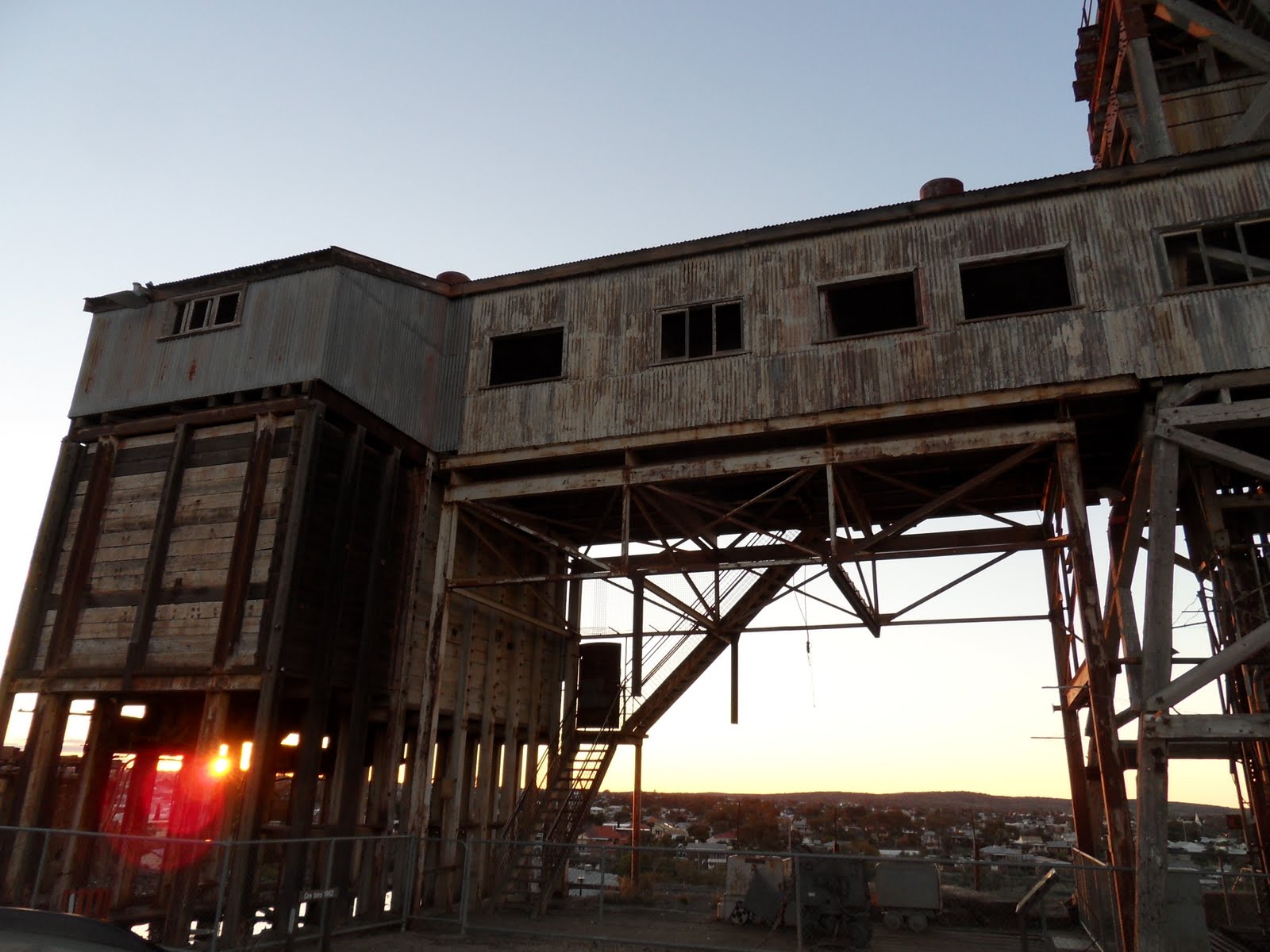
 July 8th, I travelled to Broken Hill to give a floor-talk for my retrospective exhibition "Received Moments" at the Broken Hill Regional Gallery, located in a spacious, redesigned 1882 hardware emporium (once named Sully's) in the mining city's historic Argent Street. Broken Hill, even now, still resonates with its mining past and having once photographed miners chipping away at a coalface miles beneath the Irish sea, I have nothing but respect and admiration for men who have made the decision to work beneath the earth. Gallery Director, Bruce Tindale (pictured, right, in Argent Street outside the Gallery) also took a friend, Michelle Sexton (with her small child Lachlan, and I) to the Junction mine (pictured, above left) and a more remote place to which I had always
 wanted to return - Mutawintji National Park. When I was shooting stills on Gillian Armstrong's 1992 film, "The Last Days of Chez Nous" we had filmed outside Broken Hill, including once at a magical location in
 Mutawintji, (pictured, left) after being guided there by an eloquent local indigenous man, Badger Bates. Regrettably Badger was away in Sydney, sitting on a panel at Sydney's MCA art gallery. But the timeless Mutawintji was still there, with its quiet, dry creek beds (pictured, left) that perhaps trace mysterious aquafers far below. While we
  watched, eagles swept down to devour kangaroo carcasses and flights of two and three white cockatoos (pictured, left) shrieked dry, urgent cries as they fled from us. The landscape (pictured, left) reminded me of a metaphor Australian novelist Christina Stead (1902-1983) once expressed to me, describing a giant who carelessly threw large objects into a landscape, letting them fall where they may. Around Mutawintji, gently rising ridges were occasionally lined with rows of seemingly carelessly scattered boulders, below which stra
 tas of stone pierced through the land at improbable angles, perhaps provoked by an ancient cataclysm. Returning to Broken Hill, I revisited the exhibition, noting how well it had been hung by the Gallery's assistant Darren Parker. With less space to work with than the three great chamber galleries of the Manly Art Gallery & Museum, Parker had nevertheless created a denser, but still accessible display. Also showing in an adjoining space was a provocative exhibition of layered, poignant colour photographs by Broken Hill artist Boris Hlavica (pictured, left) dealing with the cultural shocks that followed his emigration from a politically turbulent Europe to Australia. Regional Galleries are nothing, it seems, unless they show fine regional artists. Until July 18.
Post-Script: "Received Moments" has now completed its Broken Hill season and is on exhibition at Muswellbrook Regional Arts Centre, NSW until October 3.