At 75, Don McCullin forsakes war for change, rich and strangeBob Davis, an Australian documentary photographer based in Hong Kong
http://www.bobdavis-photographer.com/(
Faces of Japan - Kodansha 1978) recently sent me this link to an intriguing BBC interview with Don McCullin
http://new.bbc.co.uk/2/hi/entertainment/arts and culture/8561259.stm which suggested that the celebrated war photographer was now seeing the world very differently. In a recent exhibition held at Britain's Imperial War Museum to celebrate the veteran combat photojournalist's 75th birthday, McCullin revealed a more contemplative side to the dark vision that has brought us the horror, and savage poetry, of war for over four decades.
(One should also not forget McCullin's 1969 picture of a starving Albino Biafran child was a source of inspiration for the French doctor who created Medecins Sans Frontieres) In this current display, and a forthcoming book
"Southern Frontiers" McCullin's lens addresses architectural vestiges of the Roman Empire - not as clinically observed historical monuments - but places where one also senses a human presence, of either ruler or slave, within epic ruins. Remarkably, the first thought that came to mind looking at McCullin's latest pictures was their resemblance to vast theatrical or film sets. But these were, of course, locations where real historical dramas unfolded many centuries ago. Photographing across Lebanon, Syria and North Africa, McCullin predictably observes that these sites could not have been created without human suffering,
"it took thousands of people who perished in quarries ..." says the photographer as he movingly acknowledges the blood and sweat that must have been shed creating these now faded echoes of the Roman Empire. This photographer also revealed a new awareness of light's poetic qualities in these intriguing, timeless landscapes.
"I had to make a marriage of the light," he says enigmatically at one point in the BBC interview.
(Southern Frontiers, A Journey Across the Roman Empire (2010, ISBN: 9780224087087) by Don McCullin was published on 4th March 2010 as a large format hardback by Jonathan Cape at £50. The text was provided by Barnaby Rogerson.)Receiving Lessons From a MasterAs a young Australian photographer working in London in 1970 I met Don McCullin only once, at the Hampstead gym where British champion Heavyweight boxer Henry Cooper was deep into his training to fight a young, athletic giant named Joe Bugner - in a bout that would be Cooper's last before retiring. Looking back, the stages of my career and McCullin's could not have been at more opposite points. My generation revered McCullin's apparent fearlessness in capturing poetic, movin

g images of conflict around the world. I was a novice photojournalist, newly arrived overland from Australia, struggling to get my first picture into print in Britain. Another Australian expatriate Norman Hall, then well established as the Picture Editor of the London Times
(pictured, below L, in his office), had given me my first assignment -photographing Cooper. I arrived at the gym full of anticipation, hoping I might finally make a picture whose publication would mean, after having just completed an arduous journey overland to Britain from Burma
(with Australian artist Kate Burness) I was at least working

in London. (I would also be 12 British pounds richer!) In contrast McCullin, accompanied by a friend, seemed bored. In the brief conversation we had, he revealed he would much rather have been back in Vietnam covering the war but in the meantime the
Sunday Times newspaper had commissioned him to photograph Cooper. The dour, veteran British boxer then stepped into the ring and began his grinding routine of shadow boxing before climbing back through the ropes to pound the heavy (punching) bag. McCullin
(pictured above R) was neatly dressed in a dark suit with a handkerchief carefully placed in his top pocket, and carried a black Nikon F SLR around his neck with, presumably, a pocket full of film. (a second Nikon F materialised later) My memory records him as working quickly, concisely and very directly with the great boxer, only stopping occasionally to reach into a pocket for a different lens, or another roll of film. One moment McCullin was close to Cooper concentrating on a close-up and in the next instant had stepped back to make a more environmental observation. I soon realised I was witnessing a clinic on

the agile visual grammar of photojournalism that McCullin
(in picture at L in corner, camera raised) then employed. I stopped to watch for a while, then had to resume making my own pictures. When I did look around again, McCullin had gone. Cooper paused in his shadowboxing, leaned over the ropes and said,
"my sparring partner had to leave. Fancy a round?" Though I was slightly fitter in my youth and had once received a few boxing lessons, I politely declined, having witnessed Cooper's brutal skills, and left.
RECEIVED MOMENTS opens at Fotofreo next weekend
A few days before my touring retrospective reaches Fotofreo http://www.fotofreo.com/ in Fremantle next weekend, ABC Online Arts journalist Jenny Blain has posted this generous, thoughtful appraisal of the show in her blog http://www.abc.net.au/arts/stories/s2845940.htm
Seminal "6 Photographers" show reappears, after 55 years, at the Art Gallery of NSWOne of the most influential exhibitions of Australian photography has been revived, fifty five years after it was first shown at Sydney’s David Jones Art Gallery, in

a new display at the AGNSW.
www.artgallery.nsw.gov.au The six artists, Kerry Dundas, David

Potts, Axel Poignant, Max Dupain, Hal Missingham and Gordon Andrews sought to express, as AGNSW Assistant Curator of Photography Elizabeth Maloney writes in her catalogue essay,
“a desire for change and a new vitality ... (seeking) new directions for artistic expression ...” Mostly, but not exclusively documentary in flavour, the display also reveals David Potts’ surprising taste for abstract colour exp

loration (
pictured R), made during his sojourn in 1950's London while working for LIFE, the OBSERVER and Picture POST. With work of great compositional strength by Kerry Dundas (
pictured, above) as well as Axel Poignant’s unsentimental observations of indigenous tribal life (
pictured L) this chapter of Australian photographic history should not go unread.
Until March 7.
FINAL DAYS: Jeff Carter's Last Silver Prints at Moss Green
 How did I miss this? Just spoke to
  photographer Jeff Carter (pictured R, in 1999, at home on his Foxground Farm) www.jeffcarterphotos.com - a wonderfully insightful documentarian for over six decades of country life in Australia (as well as in its cities) and he reminded me that his final exhibition of traditionally made silver gelatin prints, the last he has personally printed in his darkroom (now closed) in rural Foxground, New South Wales, are on show at Moss Green http://www.mossgreen.com.au/gallery/current.asp in Melbourne. With just
  over a week to run, do not miss experiencing the unique spirit that inhabits Carter's photographs of Australia, far and wide. There is also a link on the Moss Green site (above) to an excellent report from the now sadly defunct Channel 9 Sunday programme (produced by Catherine Hunter and narrated by distinguished actor Max Cullen) that reveals more about this unique Australian artist. Until March 6
RENNIE ELLIS and WESLEY STACEY - 'Up the Cross'
In 1971 Ellis and Stacey collaborated on a

book about arguably Australia’s most notorious suburb, Sydney’s King’s Cross. Sadly Ellis died in 2003 but his pictures have been well preserved in the Rennie Ellis Photographic Archive
www.RennieEllis.com.au ably run by Manuela Furci and the photographer’s widow, Kerry Oldfield Ellis. Both Wesley Stacey and Rennie Ellis shared a free, engaging vision of life in the Cross and this display at the Museum of Sydney
http://www.hht.net.au/museums/mos again demonstrates this organisation’s knowledgeable support and affection for social documentary photography.
From February 20 to August 8BLENDER GALLERY rocks on with AC/DC
 Tali Udovich, Director of Blender Gallery, www.blender.com.au continues her love affair with rock with a tribute to seminal band AC/DC, currently on their sell-out tour of Australia. Not only does Udovich's exhibition address their legendary culture of performance, but she also includes moments of bone-honest backstage counterpoint, such as this gentle observation (pictured) by Rennie Ellis showing a happy, clearly exhausted Bon Scott (with Angus Young) in an Atlanta, Georgia dressing room during their 1978 tour of the United States. Until March 2Sam Haskins has left us. (1926-2009)
The influential photographer Sam Haskins (
most famous for his book Cowboy Kate - pictured at R) died on November 25, 2009 at his home in Bowral, New South Wales. I belatedly received this sad news in an email from Simon Elliot of the National Gallery which also contained this text which the photographer's son Ludwig Haskins, had posted on his father's blog
http://www.samhaskinsblog.com/?p=726
"Sam Haskins died last night. He was severely depressed after his stroke in New York in September and I suspect he suffered another smaller stroke after his return to Australia. In an act that was entirely out of character with his consistent celebration of living large, art and beauty, Sam took his own life. Alida is being cared for by friends and Oren and I are flying to Australia as soon as possible.
I genuinely thought he would pull out of his post stroke depression, I had always watched him overcome challenges with a combination of intelligence, know how, buckets of creative talent and extraordinary discipline. Unfortunately the stroke on September 19th, the day his show opened at Milk Gallery, damaged the right side of his brain and he never recovered his emotional stability.
It is always a wrenching loss to see great minds and great artists departing but Sam had a recent blessing, his last rock star moment, in New York, with the huge success of his Fashion Etcetera book launch and exhibition. That recent high note was made especially poignant by the photographers, both from New York and those who came to Manhattan from all over the world, to tell Sam that they had embarked on their careers because of his books. We lost count of the number of times that was said.
Sam's fellow professionals and fans showed him enormous warmth, love and respect in New York - those memories are very fresh in my mind - and I want to thank the people concerned.
I will post an obituary later. Ludwig Haskins (Sam's son)"
British Mountaineer/Photographer Alfred Gregory dies in Melbourne at 96
 Julie Millowick
 has informed me the photographer who documented the British 1953 Everest expedition with Hillary and Tenzing has just died. Millowick met the photographer, who lived in Melbourne until his death, at an exhibition of his Everest pictures. "Greg, as he preferred to be known, gave a talk which I attended. I then saw a huge exhibition of his Blackpool work - classic B&W reportage (made) in the 60's. Henri Cartier-Bresson was so impressed he sought Greg out and dropped in one afternoon completely unannounced." To discover more of Alfred Gregory's remarkable life and pictures visit http://www.guardian.co.uk/artanddesign/2010/feb/10/alfred-gregory-obituary
STOP PRESS: Poignant echoes from the second crash of Polaroid
I noted the New York Times of February 11 reported that Polaroid Corporation's truly amazing photography collection - featur

ing works by
Ansel Adams, Harry Callahan (pictured) Lucas Samaras, Andy Warhol, Chuck Close (pictured R), Robert Frank, Dorothea Lange and many others - will be auctioned by Sotheby's New York on June 21-22 to repay creditors injured in that inventive company's sad demise. Polaroid Corporation, founded by a true native genius of American science and business, Dr. Edwin Land,
collapsed not once, but twice, finally becoming entangled in a Ponzi scheme in its last years. The Polaroid Collection contains works made using conventional photography as well as Polaroid imaging, making this an event of international significance. According to Anne Wall of Sotheby's Australia www.sothebys.com the collection is expected to fetch up to US$11 Million.
http://www.nytimes.com/2010/02/11/arts/design/11polaroid.html?th&emc=th
"Received Moments" Completes First Leg Of Eight City Tour

My retrospective
“Received Moments” has completed its Sydney season at the Manly Art Gallery & Museum. Thoughtfully curated by Sarah Johnson (
pictured at R with Director Therese Kenyon at L) this display of more than 100 photographs attracted over 10,000 visitors during its run from early December to the end of January this year. As author of the photographs I was especially pleased with the number of my fellow photographers, both young and older, who made the trek (or relaxing ferry ride) to Manly’s spacious, inclusive environment. It has proved a rewarding, often surprising experience to open my photographic archive to another person’s examination.
Tracing the arc of a life
Sarah Johnson discovered pictures I had not thought of for years - or perhaps dismissed - and also found unlikely connections between images when she chose to create ‘narratives’ of multiple photographs within one picture frame. I also enjoyed being able to print the exhibition myself, mostly in B&W, using Canon’s Pixma Pro 9500 and Canon Semi-Gloss papers. While a small number of prints on display were vintage silver gelatin prints, the remaining digitally printed images were photographic prints in every sense I care about. These prints were uniformly neutral in B&W tonality - appropriate for what I intended each picture to say. One photographer who visited the show (who several years ago had printed many silver gelatin prints for me) announced that he liked the prints generally but he could tell which ones he had done. He then selected, incorrectly, my print of Sir Edward ‘Weary’ Dunlop. The only expectation I have for any print’s quality is that it be appropriate for the picture’s content. That the digital print quality for this exhibition did not draw attention to itself suggested this way of printing has come of age, especially for me.

That the archival permanence of Canon's Lucia pigment inks rivals and sometimes exceeds the life of silver gelatin prints is a bonus. The result was an exhibition I enjoyed visiting many times. I am grateful to Director Therese Kenyon, Curator Sarah Johnson, Gael Newton for her catalogue essay and opening speech. Manly's friendly, professional staff - Innocenza, Katherine, Catherine and Tanya Graf - were also a delight, as was the work of their fine, patient picture framers
.This exhibition was dedicated to my mother Poppy McFarlane (25.5.1916 - 2.11.2009.)
Fremantle’s Fotofreo in March is Next“Received Moments” will travel next to the FOTOFREO festival
www.fotofreo.com in Fremantle in March - though in slightly different form. A third of the exhibition will appear as framed pictures - printed as usual with Canon’s ten colour Pixma Pigment printer - with the entire exhibition (as seen in Manly) also screened in high definition in a separate display, with my commentary added for context. After Fremantle, the exhibition tours to six more Australian city regional galleries (in the same form as at the Manly Art Gallery & Museum) starting with Broken Hill in June 2010 and finishing at Cowra in June 2011. I am particularly pleased that
“Received Moments” will be viewed so extensively throughout regional Australia.
Stephen Dupont Tries Something New
While in Sydney I also visited an unusual exhibition (
pictured) with Stephen Dupont
http://www.contactpressimages.com/photographers/dupont/dupont_bio.html held in the spacious Point Piper residence of Judy and Andrew Bell. The world-ranging photojournalist was experimenting with the idea of showing his powerful black and white photographs from New Guinea and Afghanistan (made from B&W Polaroid film) within a private home - thereby offering the visitor the ‘feel’ of how these pictures would appear in a less formal environment. The effect was intriguing and vindicated Dupont’s move away from the formal surrounds of an art gallery. Art is, after all, something we live with long after its purchase from within a gallery setting. For Dupont it represented a change in how photography should be seen.
“I was looking for an alternate environment in which to build a body of work - to try and curate (a show) and see how it would look in someone’s house. It was certainly an interesting concept When you walk into a gallery ... it’s not easy to imagine how a piece of art will look in your home ... I had seen similar things in New York that were taking it to another level. I had the opportunity through the support of Andy and Judy (Bell) and I made sales which I may or may not have done (otherwise)”. Dupont added that his experiment’s success lay more in the feedback he received from people who visited the show - such as Judy Annear (from the Art Gallery of NSW) and Gael Newton (from the National Gallery in Canberra)
“It’s not easy to sell anything these days. But (my show) was similar to what artists did in the 1930's - people like Man Ray had these gatherings in their homes and they would show their art. This is just another way of having it seen.”NEWS: Stephen Dupont to join Jack Picone for Angkor Photo Workshops
Jack Picone Photography Workshops are located in the heart of Asia in Siem Reap, Cambodia’s fastest growing town and the jumping off point for the spectacular temple ruins of Angkor Wat. If a budding photojournalist wishes to acquire the skills necessary to document
'the still point of the turning world' as poet T.S. Eliot once wrote, they could do well to consider experienced international photojournalist Picone's workshops, based close to Angkor, that remarkable echo from an ancient civilization (
pictured-above) and nearby to floating villages with traditional stilted houses.
"Participants," states Picone,
"will interact closely with world-renowned photojournalists with long experience in the region ... (and) take on assignments ... advancing their photographic skills and vision." The intensive dawn-to-dusk courses will, adds Picone,
"involve challenging fieldwork, formal and informal critiques, editing sessions, evening projections and open discussion." The bonus is that award-winning photojournalist and filmmaker Stephen Dupont
http://www.contactpressimages.com /photographers/dupont/dupont_bio.html
 will join with special guest tutors and Picone
http://www.jackpicone.com to help
"participants fully engage with the local culture and environment and learn ... to create photographic reportage to the highest standard." For full information regarding costs and availability of these unique workshops, to be held June 25-30, 2010 (strictly limited to sixteen participants) please email:
jack@jackpicone.com
The Only Way To Fly - if you're Richard Green
I also met with landscape photographer Richard Green
www.richardgreen.net.au at the Manly Gallery opening who reminded me cheerfully that I had yet to accept his offer of a flight in his twin turbine EADS Eurocopter. Green (
pictured below, with his wife Carolyn and Graham Howe) enjoys the ultimate luxury as a landscape photographer - he can fly to any area in Australia that interests him, land, and photograph his personal discoveries. I had favourably reviewed Richard’s exhibition at the Byron McMahon Gallery (sadly now closed) for the Sydney Morning Herald and was captivated by the primal landscapes he seamlessly transformed into computer-stitched panoramas.

(Green told me casually his Apple Mac Pro computers needed 18 Gb of RAM to do the stitching!) By all means, I replied and we arranged to have lunch at his Terrey Hills home and then go flying.
Living Like The JetsonsCartoons such as the Jetsons once promised us a futuristic world in which flying cars were the normal means of transport. Sadly, as we approach the second decade of the 21st Century such transcendent transport seems further away than ever. Except for Richard

Green. Turning off Mona Vale road with a friend, Graham Howe (CEO of Curatorial Assistance
www.curatorial.org a California corporation that mounts and tours exhibitions) we drove down a bush track that roared with a chorus of cicadas. Richard and Carolyn Green met us at the entrance to their large, modernist house that conveniently nestled again the hangar containing

his sleek metallic bronze Eurocopter EC135. Now we were getting closer to the reality of the Jetsons. (And apart from John Travolta, who else lives with an aircraft hangar next to their home?) After a satisfying lunch (I kept thinking
‘perhaps we should eat later’) Richard and Carolyn, who can also fly a helicopter, led us down into the spotless hangar where the large, streamlined craft awaited. Green picked up the controls of an electric heli-lifter and, with one hand, eased the 2.2 tonne aircraft out onto a concrete pad that faced the vastness of Garigal National Park bushland. Prizing me into the back seat next to his wife (the Eurocopter seats seven but Green had it reconfigured for five seats) we set off, slowly taking off
backwards. After gaining height, Green expertly banked the helicopter and we sped off east (the Eurocopter can cruise at well over 140 knots) climbing quickly away from bushland that now resembled a carpet of broccoli.
Brian Brake’s Flying TripodI thought abruptly of a departed friend, the late Brian Brake of MAGNUM Photos, who once told me he regarded a helicopter as his flying tripod. During his life Brake enobled the art of aerial photography in his now legendary photo-essay MONSOON
http://nga.gov.au/Exhibitions/monsoon/index.htm. Also, I remembered Brake once photographing (for the TIME LIFE book on Sydney) Bondi Beach crowded with bathers, making their parallel bodies seem like chromosome pairs lining the Pacific shore. Suddenly, through the window of our speeding helicopter (none of my previous flights in such aircraft had approached the speed of the twin turbine-powered Eurocopter) I found myself thinking of Brake and agreeing with him - in a helicopter anything

seemed possible. Our destination was a region of the Blue Mountains (pictured - below, L) where, in January 1995, my ex-wife, the artist Kate Burness (with Bob Anderson) and I scattered the ashes of our son Morgan, who had died in an accident in Colombo, Sri Lanka on New Year’s eve, 1994. Following ancient, eroded ridges in the Blue Mountains, I glimpsed a distant gorge - perhaps (pictured - R) close to the place where we had consigned the ashes of our son.
“Would you like to land?” came Green’s voice through the headphones,
“I can see a flat rock down there.” Entering the Australian Landscape 
We rapidly descended, settling, rather than landing, onto a large flat rock where Green soon shut the engines down.
“Shouldn’t we leave them running?” I thought cautiously to myself. This, of course, was Richard Green’s vivid demonstration of his helicopter’s peerless versatility. Against a faint smell of kerosene and the much stronger perfume of eucalyptus I found myself abruptly in the stillness of the Australian bush, feeling as isolated as an astronaut. A short distance from the helicopter I could just discern the outline of two anatomically correct Aboriginal carvings of kangaroos. Later, I thought about our sudden, penetrating descent into the bush. For me this was not necessarily a better way to reach, and photograph, a timeless landscape. Though thrilling, it seemed too sudden for me, not really allowing me the time to discover the vistas I was trying to render, and I made images of little value.
“Remote and Wild” a book of Richard Green’s landscape photography, will be published nationally in March, 2010.IMAGE/TECH
Ricoh have, predictably, updated their fine compact CX2, creating an even better camera - the CX3 (RRP $499). By increasing the sensor to 10 Megapixels and adding 720p HD video capability, a good camera now becomes great for fine image making, anytime, anywhere - whether stills (the 10.7X zoom lens performed very well) or in increasingly popular HD video. The CX3 also retains Ricoh's innovative D-R dynamic range feature.
Things to come & some that are already here ...
My next blog will examine that expanding category of amazing,

capable cameras changing personal and professional photography - as well as the family album - compact ultrazooms, and a new generation of digital SLR's shooting HD video. I will also be looking at panoramic photography in cameras such as Sony's compact new HX1 - and others (Fujifilm cameras have long had the capacity to shoot triptych

es - three consecutive images digitally stitched in camera). From preliminary results (
pictured - L) Sony's well-featured, handsome HX1 (10 megapixel CMOS Exmor sensor, SteadyShot image stabilisation, Sweep Panorama, 20X Sony zoom G lens, 1080 HD RRP $899 -
pictured - R) creates panoramic photographs, in camera, that can be both epic and personal. This intriguing new feature should prove very popular.
Postscript: it was initially a little strange to use a Sony digital camera that didn't have a Carl Zeiss lens. However the Sony G lens performed beautifully. I was, nevertheless, curious to find out what role the marvellous Zeiss lenses will play in future Sony digital cameras.
Closer to Home with JULIE MILLOWICK
Returning to South Australia I was pleased to

open an Adelaide exhibition on February 19 (
part of the Adelaide Festival Fringe ) at the conservation organisation ARTLAB
www.artlabaustralia.com.au by Victorian photographer Julie Millowick (
pictured L inspecting her exhibition) Like Richard Green, Millowick
www.juliemillowick.com explores, perhaps in a more freehand, collagist way, computer-stitched panoramic landscapes in colour. She also showed a series of six haunting B&W self portraits

with her son Christian (
pictured R) These pictures were both engaged and engaging microdramas, with no scent of the overwhelming ambition to take ‘a great picture’. Millowick (
pictured L at ARTLAB) seemed more concerned with the relationship explored with her subject. I sympathize with photographers searching for the
‘great picture’ but speaking personally, this seems like putting the cart before the horse. Pictures which endure for me are only visible symptoms of how deeply photographers become involved with their subjects - no matter how briefly this may take place. W. Eugene Smith also once told me, in 1973, a photograph was only
'paper-thin evidence of a fragment of the truth.’
Until March 14MERV BISHOP and NEIL DUNCAN - Two Veterans in Different Places, Spaces

Once back from Sydney, I began to receive an avalanche of information about forthcoming exhibitions. Indigenous photographer Merv Bishop was showing his portraits of indigenous elders from Liverpool (
pictured) in the vast, refurbished post-industrial cavern of the Casula Powerhouse Arts Centre
www.casulapowerhouse.com at 1 Casula Rd, Casula. These touching, affectionate portraits of Aboriginal men and women will remain on exhibition until April 11
Fellow veteran newspaper photographer Neil Duncan
www.neilduncan.com.au was presenting
“The Works” Forty Years of Photography and Still Counting” at the Watch House Gallery, 179 Darling Street Balmain, opening on February 26. Duncan, who previously showed at Tali Udovich’s Blender Gallery
www.blender.com.au in Paddington, defies easy definition as a photographer. Obviously an accomplished newspaper photojournalist, Duncan is also one of the few photographers capable of making photographs (
pictured) that seamlessly evoke music. Using long exposures to observe moving highlights and reflections in water these poetic images instantly suggest music, especially the free forms of jazz. Duncan is also showing his documentation of workers from the once active Colgate Palmolive factory, several nudes and four decades of newspaper photojournalism. Nothing succeeds like excess!
Until March 7.FROM BEYOND THE GRAVE - Larry Burrows SpeaksBob Davis, a fine Australian documentary photographer (
Faces of Japan - Kodansha International 1978) based in Hong Kong and a friend of the Burrows family, directed me to this YouTube footage of the late, and great Vietnam war photographer Larry Burrows discussing why he pursued the dangerous profession that would ultimately claim his life in Laos in 1971. Chastening.
http://www.youtube.com/watch?v=Vc2U7nPwwCoPOINT LIGHT - where traditional photography continues to shine
Enrico Scotece finds and reveals, like the novelist Nabokov, the
‘divinity within the detail’ concentrating on the form and texture of elements found within nature. Knowing Point Light’s affection for the fine traditional silver print (and other arcane media) these images will live considerably on their delicious technical virtues. To quote Point Light’s introduction,
“He (Scotece) continues the tradition of classical photography begun in the 1830s and given new life in the twenty first century by those who appreciate its subtle alchemy.” Until March 7.
www.pointlight.com.au
ART and LIGHT - Mary Meyer Gallery
Mary Meyer's Gallery
www.meyergallery.com.au offers a stylish haven in Sydney’s Darlinghurst for collectors wishing to purchase photographic art, especially well-priced fine art prints - ranging from Australian Large Format Masters (Bruce Crowther, Bob Kersey, Stephen Tester
Oberon Shadows-pictured
 & Richard White) with their poetic observations of the landscape - to Peter Solness’s remarkable illuminated colour night landscapes (which I have described in detail in previous blogs) Solness
www.solness.com.au continues to widen his palette, finding even deeper insights (
pictured) into the Australian nocturnal landscape.
Until February 28Solness is going back to his Secret GardenSolness's nocturnal landscapes will also be seen in a new display
"The Secret Garden"
at the Hazlehurst Regional Gallery, 782 Kingsway, Gymea, near where the photographer grew up.
"This (new) exhibition is a celebration of the stunning ... primal beauty of the Royal National Park ... where I spent a lot of time over the years as both surfer, photographer and bushwalker. It was also a great place to escape during my school days too." Solness is hoping some of his old school friends from Blakehurst High School will come to the opening to 'catch up'.
From March 6 to March 16MAGNUM Photos - For SaleI recently noted a New York Times report that Magnum Photos
http://blog.magnumphotos.com/ had successfully placed their impressive archive up for sale and, while member photographers retain image rights, it marks a profound shift in the continuing, troubled role of photojournalism in the internet age. Clearly this pioneering photographers' cooperative now enters a climate of re-invention, coupled with academic study (it will be housed within the University of Texas) For the full New York Times article go to:
http://www.nytimes.com/2010/02/02/arts/design/02magnum.html?th&emc=thJON LEWIS - Putting a Face to Climate Change
Documentary photographer Jon Lewis
www.jonnylewis.org has been documenting changing lives in Kiribati, one region of Oceania that will be among the first affected by global climate change. Lewis appears indelibly linked to the ocean and its communities, having documented the peoples of Bougainville, East Timor not to mention indigenous Australia and Lewis's pictures of early Greenpeace whaling protests. This Australian photographer’s ongoing act of witness to the islander world can seen at the Monash Gallery of Art
www.mga.org.au 860 Ferntree Gully Road, Wheeler's Hill, Victoria U
ntil April 11
SHANE HULBERT - The Beauty Found Within Post-Industrial Landscapes
Shane Hulbert from RMIT University, has a solo exhibition
'Expedition' at the Centre for Contemporary Photography
www.ccp.org.au in Melbourne in which he eloquently conveys a desiccated world devoid of people - perhaps as society may appear with the passing of civilization.
More work can also be seen on his website at
www.shanehulbert.com Until March 14.LAURENCE ABERHART - "This Is What I Do"
I last reviewed Laurence Aberhart’s immaculate observations of Maori Northland churches for the Sydney Morni

ng Herald two years ago. This time the distinguished NZ photographer offers an equally evocative exhibition at the Darren Knight Gallery
www.darrenknightgallery.com depicting seemingly ordinary vistas encountered within suburban New Zealand and, in one remarkable portrait, (pictured, L) the phenomenal that can sometimes reside within the human face.
Until February 27.A JAPANESE VISION OF PHOTOGRAPHY - Gazing at the Contemporary World: Japanese Photography from the 1970s to the Present. The Spirit of 'Notan' Lives On.
Curated by Rei Masuda, Chief Curator of the National Museum of Modern Art, Tokyo, this exhibition features photographs by 23 internationally renowned Japanese photographers (including Nobuyoshi Araki, Shomei Tomatsu and Daido Moriyama) and aims to reveal
“a panoramic view of Japan’s changing landscape since the 1970s.” Japanese photography has a unique vision and any opportunity to see works by the astonishingly prolific Nobuyoshi Araki (and many others) should not be missed. At the Japan Foundation, Level 1, Chifley Plaza, 2 Chifley Square, Sydney.
From February 22 to March 4KIDSXPRESS - Life Through A LensMP Linda Burney, NSW Community Services Minister, knows something about photography, having once heard her deliver an eloquent 2004 eulogy for indigenous arts photographer Michael Riley. Ms Burney was guest speaker for Kidsxpress at the Art Gallery of NSW on February 17. Kidsxpress
www.kidsxpress.org.au are searching for a suitable venue for an exhibition of photographs by children, who received disposable cameras when they underwent that organisation's expressive therapy program (interfacing music, art and drama therapies).
PAUL FERMAN - speed and stillness
In presenting two separate themes in his show

at King Street Gallery
www.kingstreetgallery.com .au on William, Ferman
www.paulferman.com first offers fractured perceptions he experienced on a European TGV train travelling past bridges at 350km per hour (
pictured-R) juxtaposed with his manipulated images of late Renaissance sculpture morphing into industrial detritus (
pictured- L) Hardly lyrical subjects at first glance but typical of Ferman’s passionate dedication to walk a personal, if sometimes unfashionable artistic path. Was it Henri Cartier-Bresson who, when asked what his photographs meant, exclaimed,
“But of course, they represent a line between the external world - and my inner life!” Ferman’s photographs are worthy of such scrutiny.
Until March 6
Head On approaches!
That time of year is nearing when Australian photographers should examine their consciences and choose their best portraits for the now well established Head On portrait competition. Here is the review I wrote of last year's display - featuring Gary Heery's
www.garyheery.com Critic's Choice winning portrait of Cate Blanchett. Head On will also evolve into a fully fledged photo festival, opening at the end of April. Full details of Head On's newest incarnation and entry forms can be found at
www.headon.com.auNOMINATIONS announced for World Press Masterclass in EuropeThe four photographers chosen to be nominated from Australia and New Zealand have been announced by the committee for selection, chaired by noted Australian photographer Philip Quirk: They are Marisol Da Silva, Mitchell Kanashkevich
http://www.mitchellkphotos.com, Sean Davey
www.pidgin.com.au from Australia and Tim Veling
www.timjveling.com from New Zealand. As Adam Ferguson
www.adamfergusonphoto.com from Australia was a runner up last year, he automatically also receives a nomination this year. Judging from other photographers who have participated in this event, it can be a career, if not life-changing experience. We wish them well.
Text Copyright Robert McFarlane 2010 www.robertmcfarlanephotos.com Please note the following contact details on my website have been changed. My email address is now
archive@robertmcfarlanephotos.com and my mobile phone number is now
0422 841 466.
 I have just been reminded that there is still time for Australian photographers to enter one of this country's most accessible, beautifully presented and rewarding photographic competitions - "Sydney Life". (submissions close 5pm Tuesday, May 25) As part of the City of Sydney's free public arts festival "Art & About", this annual event is remarkable for three things - displaying works chosen in beautifully reproduced, bedsheet sized images along the length of the central walkway (pictured in 2009 in photograph by Sharon Hickey, above) bisecting Sydney's Hyde Park North - from the Archibald Fountain to Park Street. The second is the quality of the images themselves. I have never been bored by judges' choices in past competitions with the quality of entries being consistently high. This year I would hope to assist in continuing this tradition as I have been invited to join judges - Arthere producer and Stills Gallery curator Sandy Edwards, artist and curator Ace Bourke and the City of Sydney's Director of City Engagement, Alastair Walton. The third tier of this competition is the generousity of the "Sydney Life Prize", for the most outstanding entry - $10,000. Entrants whose works are chosen for display also receive a $400 appearance fee. Judges are looking for original, non-stereotypical ways of portraying life in Australia's great harbour city. All is explained in the "Sydney Life" artist's brief and entry form at www.artandabout.com.au
 The founding Director of Fotofreo, Bob Hewitt, credits me with re-naming this remarkable biennial photography celebration, Fotofreo-athon because of this event's complexity and the sheer endurance needed to celebrate the medium, as so comprehensively presented in Fremantle. That photography maintains it artistic primacy despite the emergence of new media - HD video, 3D Motion Pictures and the viral, fast-growing social networks on the internet - reflects its power. As both a conveyance for the often appalling business of the planet, as well as a dynamic fine-art medium - photography continues to grow, unabated. It is now equally at home as a documentary medium as well as the conceptual, constructivist way of making photographs. This year's Fotofreo http://www.fotofreo.com/was, however, strongly orientated to what Bob Hewitt described to me as 'conflict photography', perhaps too much so, he casually confided on my final, rushed trip to Perth airport after everything was over. However, the answer to this enduring question is elusive. Unpalatable as it is, news of tragic events is important and needs such remarkable, courageous talents as David Dare Parker, Martine Perret and Philip Blenkinsop (all present and exhibiting at Fotofreo) to bring it to us. Would we rather the alternative be (photographic) silence?
 On
On  reflection, Fotofreo appears perfectly suited to a city such as Fremantle - a relaxed, unpretentious community where living comfortably appears the norm. Except for the explosive moment which occurred during my floor talk for "Received Moments" at the Fremantle Art Centre. After generous introductions by Bob Hewitt and Graham Howe of Curatorial Assistance http://www.curatorial.org/ the heavens opened and the most severe electrical storm to hit Fremantle (and Perth) for decades, descended upon us. For a moment we were deafened by thunder and mounted pictures began to swing alar
 mingly away from the walls - especially my 1963 portrait of Charlie Perkins. "Is that you, Charlie?" I adlibbed to faint amusement. The storm continued for hours, causing the cancellation of several Fotofreo openings and leaving the city bruised by hail and briefly flooded (pictured, above). Several days later we gathered in the late afternoon at Bob and Helen Hewitt's home for a relaxed Indian dinner. Here, as in previous Fotofreos, were some of the reasons why this well organised, inclusive gathering of photography lovers grows so naturally. Blenkinsop (pictured above) brushed shoulders with Sandy Edwards http://www.arthere.com.au/ just arrived from Sydney - and Peter Eve http://www.monsoonaustralia.com/ recently back from documenting the genius inherent in indigenous Aussie Rules, as played by Tiwi islanders. Laura Beilby, formerly from
 Magnum in Paris, administered Fotofreo (with Amelia Twiss) without any panic, taking much of the load from
  overworked Fotofreo stalwarts such as Dare Parker and Hewitt. Dean Sewell an
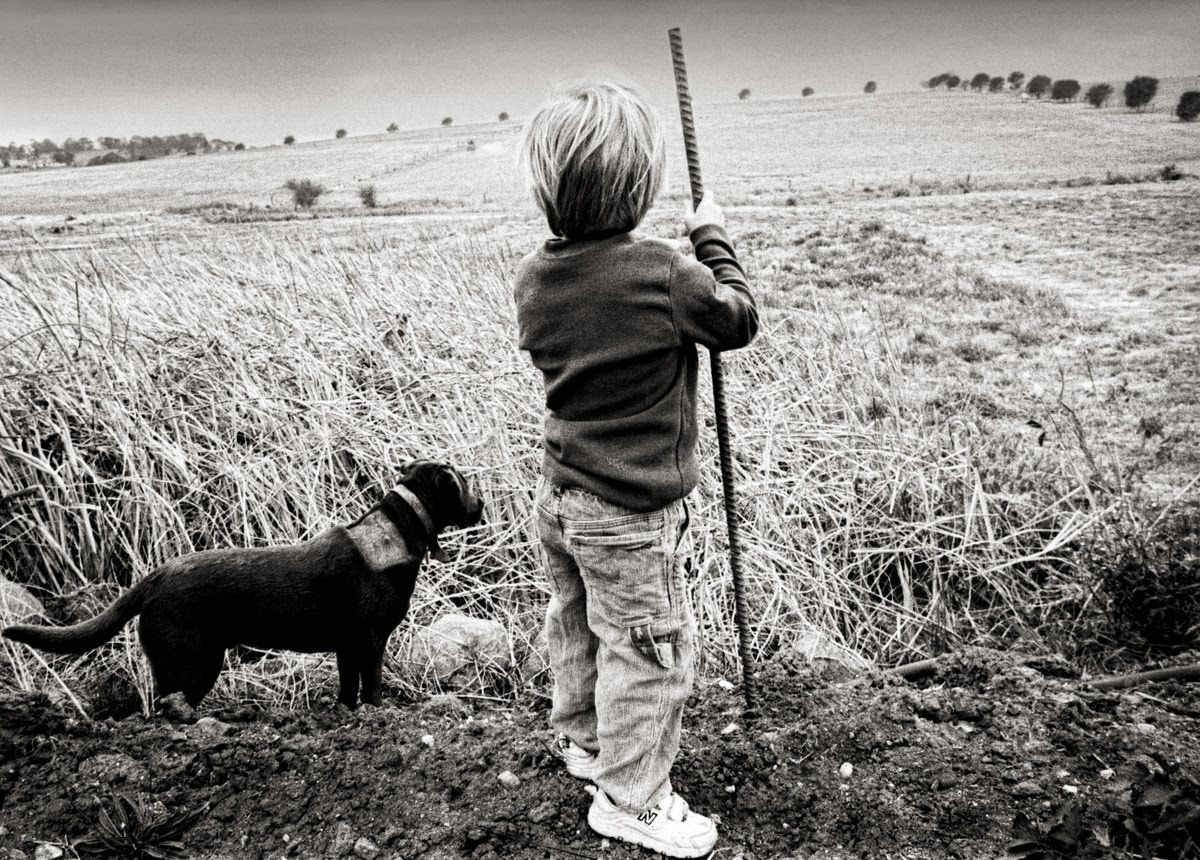 d Tamara Dean were also present - both as eloquent as ever about the blurring lines between narrative and conceptual photography. Fotofreo also seems to have taken a leaf from Adelaide's Arts Festival know-how by including a flourishing series of Fringe events. Dean Dampney http://www.submerge.com.au/from NSW had an unsentimental, delightfully honest exhibition of B&W pictures, on show until April 11 "From Innocence and Back" mostly of the world of children (pictured, above) at Early Work Gallery www.earlywork.com.au run by Kate Lindsay (pictured above R) Jennifer Schulz took her "Finding Places" exhibition of landscapes to University of Western Australia, with some scenes quite prosaic - others distinctly illusionist. Schulz, (pictured above L) transformed a section of W.A.'s famous Wave Rock, making it seem more liquid than stone) And in an all too
  brief conversation with the ever acute Blenkinsop http://www.noorimages.com/ he lamented the increasing need for speed in media - especially photography. Still shooting film for assignments but carrying a Nikon D90 SLR ("it's for the [HD] video", he explained) this remarkable 'conflict' photographer did not appear even close to succumbing to digital image-making. Another fine photographer still shooting film, this time colour, was Brad Rimmer (pictured L) who had instead returned to the rural Western Australian wheat belt where he grew up, to photograph for his book SILENCE. Rimmer's photographs were distinguished by capturing his subjects during long, revealing moments - and seemingly trivial pictures such as extravagant skid marks on country roads - the dangerous calligraphy left by boredom in the bush.
 Jim Marshall, one of Rock and Jazz music's finest photographers has died in his sleep in New York at the age of 74. Famous for his documentation of the explosive music counter-culture in the U.S. during the 1960's and 70's, Marshall, perhaps best known for his work for Rolling Stone magazine, captured a generation of musicians with affection, insight and above all, intimacy. Capable of containing a 1968 performance by the Grateful Dead (pictured above) in Haight Street, San Franscisco for over 100,000 fans into a single, intimate photojournalistic observation, taken from the stage on which the band was performing, Marshall http://www.marshallphoto.com/collection has left us a priceless archive from a turbulent era. Marshall's photography of rock and jazz was most recently exhibited in Australia last October by Blender Gallery www.blender.com.au in Sydney's Paddington. "I am planning to mount a retrospective (exhibition) to commemorate Jim's life's work as soon as possible," said Blender Gallery director Tali Udovich.
 Just as I headed East after an exhausting but rewarding six days at Fotofreo, an interesting range of exhibitions are on view in Sydney and Melbourne. Rather than focus on one exhibition, I will simply draw your attention to shows you might find rewarding - or perhaps challenging. In Sydney Tony Peri http://web.mac.com/tonyperi/is swimming harder than ever against the digital tide - to spectactular effect. Recently returned from an image odyssey through Italy and venturing as far North East as Hungary (Peri's late father Otto was Hungarian) the Sydney photographer has mounted an exhibition (at Chatswood's Mezze Cafe www.mezzecafe.com) of bromoil prints (Ancient Roman Forum, pictured above) made back in Sydney from photographs originally taken abroad - using a 35mm Voigtlander Bessa R with five lenses (75, 35, 21, 15 and a venerable, collapsible 50 Elmar.) When I asked him why he pursued a printmaking technique that reached its peak in the 19th century, Peri's answer was disarmingly simple. "I want to be different from everyone else ... they (Bromoils) lend their style to my vision. There is a real beauty and archival permanence about them. Bromoils bring out a mood of the photograph and (when) you control the inking process ... photographs really come alive. There is 150 year of history (in photography) that I don't want to throw away." After seeing Peri's images, it seemed to me that making Bromoil prints (a difficult and time consuming process) is well suited to interpreting the historic vistas that this dedicated photographer discovered in Italy, some aged in millenia. Until April 14
 In Sydney, documentary photographer Mayu Kanamori www.mayu.com.au again examines mortality in a thoughtful exhibition, and performance, at the Japan Foundation http://www.jpf.org.au/ in Chifley Square. Her series of gently iconic photographs address the conundrum of what it means to be Japanese - to die and be buried far from home. As a Japanese woman who has lived in Australia for many years, Kanamori seems philosophically resigned to the fact that Australia will be her last resting place. "This work is very important to my soul ... through burial, I too will be part of this Australian landscape one day ..." Mortality is not a new subject to this photographer - having once collaborated with her distinguished journalist partner Ben Hills, and creating pictures for their 2009 book "The Island of the Ancients" on the centenarian citizens of Sardinia. Kanamori, however, has found new graphic subtlety in these latest photographs - fusing sand, stone, flesh and earth into restrained, resonant colour photographs.
  Sleep is nothing new to Sydney photographer Martin-McGuire. I reviewed an engaging show at Customs House, Circular Quay a couple of years ago called China Dreaming, made when this photographer was working in Shanghai. Now she has returned to a similar theme with "Sleepers" at the Australian Centre for Photography http://www.acp.org.au/in Paddington, Sydney. "Slee
 pers is my first series - conceptualised and highly produced" done as part of this artist's MFA (Master of Fine Art) Research Degree at Sydney's College of Fine Art (COFA) "It is still under the theme of Waking Dream States." says Martin Maguire. "I strapped a beautiful, top quality digital Hasselblad to the ceiling of a photography studio and photographed ... people and couples as they fell asleep. I was hoping to catch the psychology of the shell (body) once ... inhibitions of consciousness were gone. I was hoping to make it look like a dance across the walls." Martin-McGuire http://www.oliviamartinmcguire.com/seems seduced by both the intimacy and unreachability of sleep, as a subject. "Those internal journeys remain private" she says, "no matter how much other people may desire know what lies inside. We can watch others, think we understand, but they may be dwelling in far away places we can never know."
  Perhaps the most ambitious exhibition currently showing (for only a few days more) is Isobel Crombie's thoughtful assay of the international photography collection at the National Gallery of Victoria. http://www.ngv.vic.gov.au/ Re_View is, one feels, like a meeting with old friends - witnessing Ansel Adams' planetary landscape "Clearing Winter Storm, Yosemite Park 1944" (pictured above) and Andre Kertesz's wilting "Melancholic tulip, February 10, 1939" (pictured below L) and. going further into the past, seeing Eadweard Muybridge's amazingly candid (for its time) "Lifting cloth from the ground, placing it around shoulders and turning, 1887" in which a young, nude woman, with neither modesty nor artifice, performs this simplest of movements for Muybridg
 e's sequential camera. The leap in perception required to achieve this pioneering photographer's understanding of human (and of course, Animal Locomotion) is, for the prudish times in which Muybridge lived, literally astonishing. There are other, more predictable masterpieces (Edward Weston, Julia Margaret Cameron, Walker Evans and Dorothea Lange) sprinkled through this display but I confess to being disappointed to see Robert Frank being represented by one of his merely adequate 1953 images made of Welsh miners in Britain - rather than anything from his epoch-defining 1958 work, The Americans - which, it could be argued, remains one of the most influential books of the last half century. The book's essay writer Jack Kerouac rightly described Frank as having "sucked a sad poem right out of America onto film." This book still resonates in its ability to see beneath American's fertile capacity for mythmaking. Perhaps the most magical image in this collection is the soaringly imaginative colour photograph Crombie chose for the lavish, well reproduced catalogue's cover image - Yee I-Lann's "Huminodun 2007". In this fine example of photographic magical reality (pictured, below), a
  pregnant woman's flowing black hair takes on a life of its own and soars away from the dreaming young woman, embracing fecund rice plants in the landscape and providing, explains Crombie, " a poignant reminder of how much the indigenous people of Malaysia are in danger of losing in the face of increasing consumerism and modernisation ... it is as the artist writes, her lament for Sabah."